

Is IPTV Legal in Norway? Essential 2026 Guide to Avoid Risk
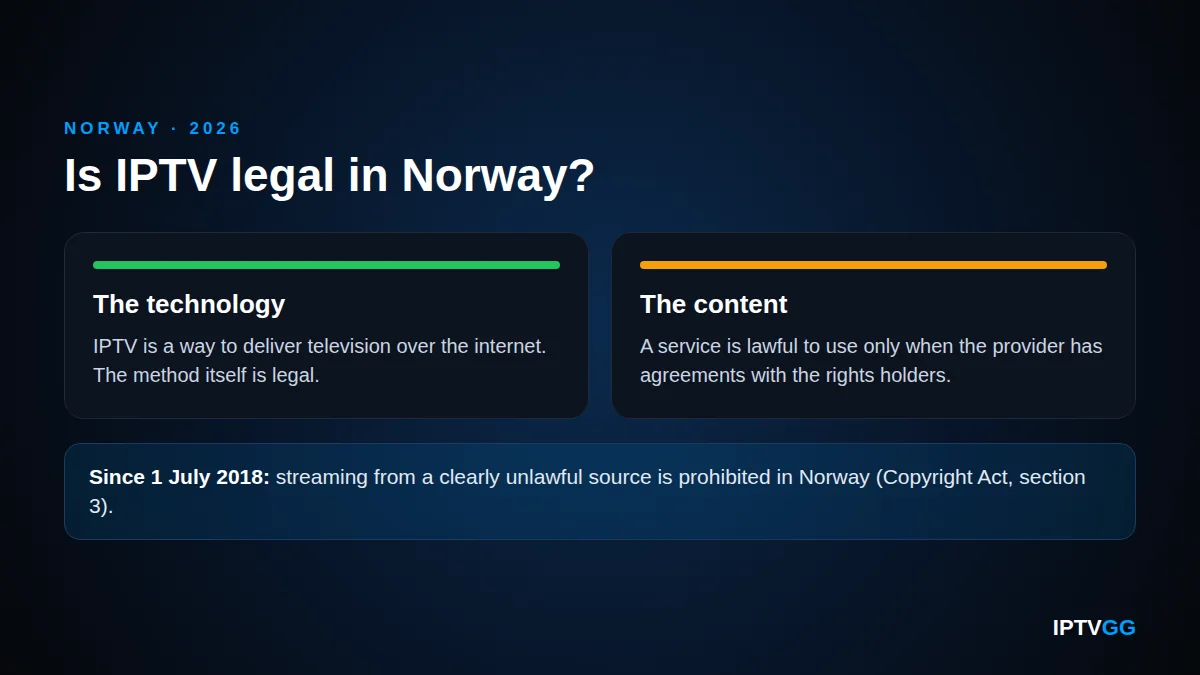
Is IPTV legal in Norway? Yes, the technology itself is legal, but each service must have the rights to the content it shows. IPTV is only a way to deliver television over the internet. Since 1 July 2018, the Norwegian Copyright Act has also made it unlawful for viewers to stream content from a source that is clearly unlawful.
Key takeaways
- The short answer to “is IPTV legal” is yes for the technology. IPTV is only a delivery method.
- Legal IPTV depends on the provider. A service needs agreements with the rights holders for the content it shows.
- Since 1 July 2018, section 3 of the Norwegian Copyright Act has prohibited streaming works from a clearly unlawful source, when this is likely to cause significant harm to the rights holders.
- The Act provides for fines or imprisonment for up to one year. Courts can order internet providers to block websites.
- Ask every provider which rights it holds before you pay.
This article is general information, not legal advice. It describes the rules as we read them in official Norwegian sources in 2026.
Is IPTV legal as a technology?
IPTV means Internet Protocol television. The picture reaches you through an internet connection instead of an antenna or a satellite dish. Nothing in that method is unlawful.
The Norwegian Communications Authority (Nkom) uses IPTV as an example in its guide to net neutrality. It names IPTV in fixed networks as a well-known “specialised service” that an internet provider may offer next to internet access. See Nkom’s explanation of net neutrality.
So when people ask “is IPTV legal”, the honest reply starts with a correction. The law does not judge the technology. It judges what is sent, and whether the sender has permission.
Is IPTV legal when the provider has no rights?
No. Films, series and TV programmes are protected content, and a service needs agreements with the owners of the rights. Medietilsynet, the Norwegian Media Authority, says the same in a public answer on ung.no: lawful streaming services have made agreements with the rights holders. If content is published without such an agreement, it can be unlawful to stream it. See Medietilsynet’s answer about streaming films and series.
A properly licensed provider gives you legal IPTV. A provider that sells content without permission does not, even if the app and the picture look the same.
Is IPTV legal to stream under the Norwegian Copyright Act?
To answer “is IPTV legal” in Norway, start with one law: the Copyright Act, in Norwegian åndsverkloven. Its reference is LOV-2018-06-15-40, and Lovdata lists 1 July 2018 as the date it came into force. The full text is on Lovdata: åndsverkloven (LOV-2018-06-15-40). It is in Norwegian, so the English wording below is our own unofficial translation.
Section 3, third paragraph, is the rule that concerns viewers. In our translation it says: it is not permitted to stream, or otherwise use, works that have clearly been made available to the public in breach of this Act on the internet or another electronic communications network, when use from the unlawful source is likely to cause significant harm to the author’s economic interests.
For a viewer, “is IPTV legal” turns on three conditions. All must be met:
- The work has been made available in breach of the Act.
- This is clearly the case. The Norwegian word in the Act is åpenbart.
- Use from that source is likely to cause significant harm to the economic interests of the rights holder.
The government explained the idea when it presented the bill. The main rule stays: a person who browses the internet is not responsible just because material was posted unlawfully. The bill added an exception, so that in certain cases it is unlawful to stream protected content. Its example was a film that has obviously been posted in breach of the Act. See regjeringen.no: the new Copyright Act.
What “clearly unlawful” means for a viewer
The Act contains no list of signs. Medietilsynet describes the test in plain words: for you to be punished, it must be obvious that the website does not own the content, and you must stream it even though you are aware of this.
The paragraph uses the word works, in Norwegian åndsverk. Medietilsynet gives films and TV series as examples. How the rule applies to other kinds of content is a question for a lawyer.
This is why “is IPTV legal” cannot be answered with one word. Pressing play can be lawful or unlawful. It depends on the source and on what was clear to you.
Is IPTV legal if you only watch and never share?
Many people who search for “is IPTV legal” believe that only sellers and uploaders can break the law. That is no longer correct in Norway. Since 1 July 2018, streaming from a clearly unlawful source is prohibited, even if you never download, record or share anything.
What consequences does the Act provide?
- Criminal penalty. Under section 79, a person who breaches section 3, or certain other sections, is punished with fines or imprisonment for up to one year. The Act names no amounts.
- Payment to the rights holder. Section 3 states that remuneration and damages under section 81 can only be imposed for an intentional breach of the streaming rule.
- Stricter rule for gross infringement. Section 80 allows fines or imprisonment for up to three years. It refers to the first and second paragraphs of section 3, on copying and making works available. It does not refer to the third paragraph on streaming.
Medietilsynet sums up the viewer’s position in a second public answer about section 3. If you use clearly unlawful content on purpose, you can be punished with fines, among other things. In that answer, from 2023, the authority wrote that it did not know whether the rule had ever been enforced. We found no official statistics, so we make no claim about how often viewers are fined.
Uncertain enforcement does not make an unlawful act lawful. Anyone who asks “is IPTV legal” should plan on what the Act says.
Can Norwegian internet providers block streaming sites?
Yes. Under section 88, a court can, on request from a rights holder, order a service provider to prevent or impede access to a website where material that clearly infringes rights under the Act is made available on a large scale.
The section also sets limits. The reasons for an order must weigh more than the disadvantages. The court has to consider freedom of information and expression, and whether less intrusive measures are possible.
Blocking has been used in practice. In September 2015, Oslo District Court ordered a group of Norwegian internet providers to block several file-sharing and streaming websites, as reported by Dagens Næringsliv. That decision used the blocking rule that applied then. Today the rule is in section 88.
Nkom’s net neutrality guide fits with this. As a main rule, an internet provider may not block or slow down specific applications. The exceptions include measures imposed through legislation or by the courts.
A block does not settle “is IPTV legal” for every service, but it has a practical side. A service that depends on a blocked address can stop working overnight. This article does not advise anyone to get around a court-ordered block.
Nkom and Medietilsynet: who does what?
Readers who search for “is IPTV legal” often expect one authority to hold the answer. Based on their own descriptions, the roles are split.
- Nkom describes itself as the supervisory and administrative authority for postal and electronic communication services in Norway. It supervises net neutrality. See Nkom’s English pages.
- Medietilsynet describes itself as an independent government body and the regulator for radio, TV and other audiovisual media services. It is subordinate to the Ministry of Culture. See Medietilsynet’s organisation page.
- The courts decide blocking requests under section 88. The Act sets out penalties and claims for payment.
The official descriptions we read do not mention any approval scheme for individual IPTV subscriptions. Be careful with a seller who says an authority has “approved” a subscription but cannot show where. The rights check, and so the answer to “is IPTV legal” for that service, stays between you and the provider.
Is IPTV legal with your provider? How to recognise a licensed service
You cannot see a provider’s contracts, but you can look for practical signs. The table is a consumer guide, not a legal test. No single row is proof.
| What to look at | Points toward a properly licensed service | Reason for caution |
|---|---|---|
| Rights | The provider can say which rights it holds, for which content and for which countries. | Questions about rights are avoided or answered with slogans. |
| Identity | A company name and working contact channels are easy to find. | There is no information about who runs the service. |
| Catalogue and price | The price is realistic for the amount of premium content. | Almost every premium channel and new film is offered for a very low price. |
| Terms | Clear terms of use and refund rules. | No terms, or terms that do not match what is sold. |
| Marketing | The service describes what it offers in plain words. | The service advertises that it gets around blocks or regional limits. |
If several rows in the right column fit, the source may be clearly unlawful. Then “is IPTV legal” has a clear answer for that service, and the answer is no.
Six steps before you pay
Use these steps to answer “is IPTV legal” for one specific service.
- Ask the provider in writing which rights it holds for the channels or films you want to watch in Norway.
- Find out who is behind the service.
- Read the terms and the refund rules before you order.
- Compare the price with the amount of premium content.
- Test the service first, and choose a short first period.
- Save the answers you get. If the answers are unclear, do not subscribe.
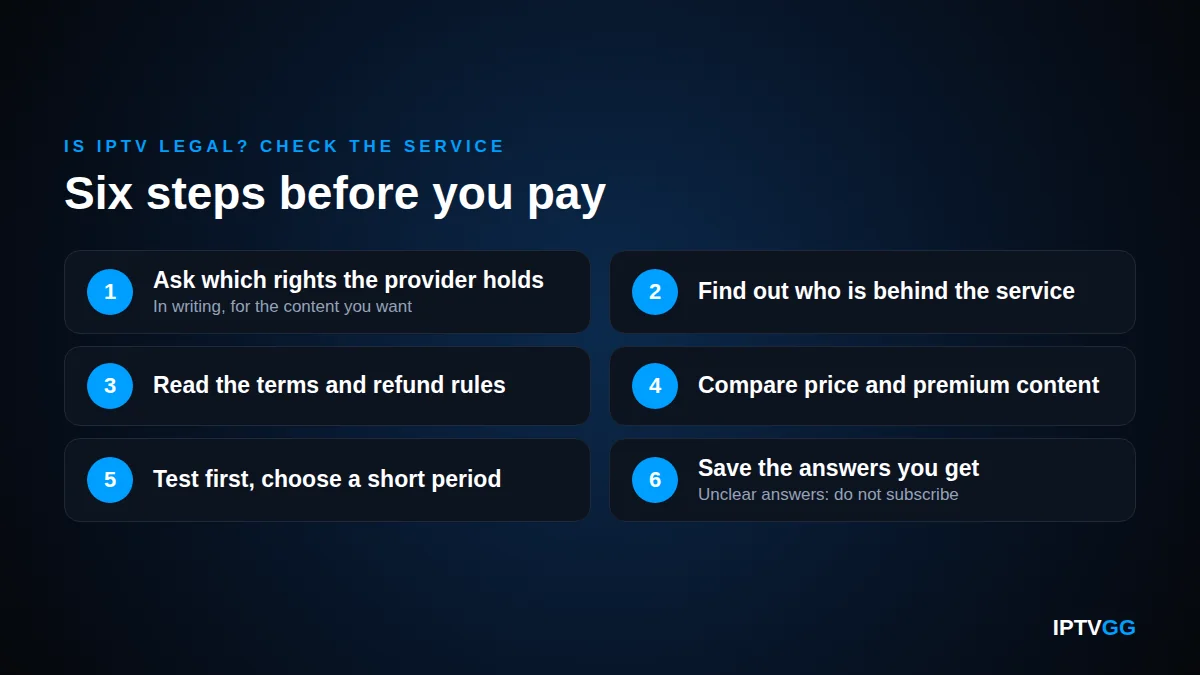
These steps help you find legal IPTV and avoid a clearly unlawful source. They also protect your money, because a blocked or closed service can take a prepaid period with it.
Picture quality and device setup say nothing about content rights. They are covered in our guides to internet speed for IPTV in Norway and installation on each device.
Is IPTV legal: frequently asked questions
Is IPTV legal in Norway in 2026?
Yes, as a technology. IPTV only describes how television is delivered over the internet. A service with agreements from the rights holders is lawful to use. A service that clearly offers content without permission is not, and using it has been unlawful in Norway since 1 July 2018.
Is IPTV legal to watch if I never download anything?
Not always. Section 3 of the Norwegian Copyright Act covers streaming, not only downloading. You may not stream works that have clearly been made available in breach of the Act, when this is likely to cause significant harm to the rights holders.
Can I be fined for using an unlawful IPTV service?
The Act allows it. Section 79 lists section 3 among the rules that can be punished with fines or imprisonment for up to one year. Medietilsynet explains that punishment requires an obviously unlawful source and a viewer who knew. The Act sets no fixed amounts.
Can my internet provider block an IPTV service?
Yes, if a court orders it. Under section 88, a rights holder can ask a court to order an internet provider to prevent or impede access to a website with clearly infringing material on a large scale. The court must weigh this against other interests, including freedom of information and expression.
How do I know if a provider offers legal IPTV?
Ask in writing before you pay. A provider with agreements can normally say which rights it holds and for which countries. Also check who is behind the service, read the terms, and compare the price with the amount of premium content. No single sign is proof.
Is IPTV legal just because it has a free trial or a low price?
No. A trial, a discount or a refund policy tells you about the sales terms, not about content rights. A service is lawful to use only when the provider has permission from the rights holders. Use a trial to test quality, and ask the rights question separately.
Is IPTV legal for you? Ask first, then test
For readers in Norway, the answer to “is IPTV legal” is short. The technology is allowed. A clearly unlawful source is not, and the law has said so since 2018. Ask any provider which rights it holds before you decide.
The same advice applies to IPTVGG. This article makes no statement about content rights for any channel or title on our service. Before you pay, ask our support team about the content you plan to watch. Write on WhatsApp at +212 601 675807, send an email to support@iptvgg.com, or use the contact page.
To test the service, the 24-hour free trial costs nothing and needs no card. The trial login is sent on WhatsApp. You can check the plans first, and the FAQ page covers practical questions.
Paid plans start from €12.99 for one month on one device. You do not enter card details on the website. You fill in the checkout form and confirm the order and payment with support on WhatsApp. A refund can be requested within 24 hours of activation.
This article is general information, not legal advice. Laws and practice can change. Check the current text on Lovdata or ask a lawyer.